
The’Artificial Intelligence She entered the classroom, and not on tiptoe.
Ever since tools like ChatGPT became part of daily use among students and teachers, AI has been reshaping teaching methods, professional roles, and school organization.
The changes concern not only technologies, but the very questions about what it means teaching and learning today. The etymology of the word education, from the Latin educate, “bringing to light”, reminds us that teaching means bringing out from the minds of students potential, insights, knowledge. Today, however, in a context where answers can be generated in a few seconds by an algorithm, learning risks being reduced to prompt management and output production.
What role does a written assignment have if it can be completed in a matter of seconds by a Gen-AI? How do you truly assess comprehension? And what skills are needed to navigate a world where writing with AI will be part of daily work and social life?
In this article we explore, with a look at the Italian context and a comparison with some European best practices, the opportunities, challenges, key skills and strategic priorities to build a a school capable not only of integrating AI, but of doing so in a critical, ethical, and human-centric way.
How AI Personalizes Learning
If there is one area where Artificial Intelligence shows its educational potential, it is in personalization. The idea of adapting teaching to the needs of the individual student is finally becoming feasible thanks to AI. We are no longer just talking about differentiation by teachers, but of intelligent systems capable of building personalized itineraries in real time, based on the data generated by the students themselves.
AI-enhanced educational technologies, such as intelligent tutoring systems (Intelligent Tutoring Systems), constantly track each student's progress, identify difficulties, and anticipate needs. They are designed to automatically adjust the difficulty level of exercises, provide immediate feedback, and suggest alternative content or different learning strategies. In this way, every student can progress at their own pace, receive help when needed, and consolidate what they have learned without feeling either held back or left behind.
Some examples are already widely documented: platforms such ASSISTments in the United States, which offer formative feedback in mathematics, or Mindspark in India, which has proven to reduce gaps between students with different starting levels, thanks to its ability to target educational materials in a focused way.
Inclusion and accessibility: AI as a lever for equity
Another fundamental aspect concerns the potential of AI in creating more equitable and accessible learning environments. Artificial Intelligence-based technologies can be configured to support students with special educational needs (SEN) or specific learning disabilities (SLD), offering for example text-to-speech, automatic transcriptions, adaptable visual interfaces, instant translation, and multisensory environments. This approach is inspired by the principles of’Universal Design for Learning (UDL), which promotes an inclusive education capable of adapting to different styles and needs right from the design stage.
Some emerging educational AI models they are going beyond supporting student needs, shifting the focus to valuing the individual strengths. This is an approach strengths-based, which aims to bring out less visible talents and potential in standardized pathways, customizing the educational path based on the unique characteristics of each student.
What is happening in Italy and Europe
In Italy, two educational institutions, the Majorana High School in Brindisi and the’IC III of Modena, have been participating in the OECD project since 2023 “AI and the Future of Skills (2023–2025)”, which studies the application of AI to personalize educational paths in schools, with the aim of testing intelligent solutions that can integrate, and not replace, the educational work of teachers.
In the university context, the Polytechnic University of Milan, for example, has experimented with predictive models to identify students at risk of dropping out and intervene in time with personalized support pathways.
In the European landscape, several countries are investing in digital strategies that include elements of personalization and inclusion. France, for example, the program Educational Digital Territories It provides for the loan of digital devices and tools to 15,000 male and female students in socio-economic vulnerable conditions, with the aim of ensuring equal opportunities for access to learning. During the pandemic, the supply of accessible and adaptive digital resources supporting various learning modes was also enhanced. In Netherlands, work has been done to make digital education fairer, starting from school curricula. At the same time, national mappings have been launched to monitor how Artificial Intelligence is being introduced and used in schools, with the aim of evaluating teaching effectiveness, ensuring the accessibility of AI solutions, and analyzing potential impacts on teaching and learning.
More learning, less performance anxiety
One of the most promising aspects of using Gen-AI in the classroom is the reduction of academic pressure. Thanks to tools like adaptive tutoring, students can learn at their own pace, receiving targeted and immediate feedback that enhances self-regulation, motivation, and self-confidence. This approach helps overcome constant comparison with peers, which is often a source of anxiety, instead valuing individual progress and creating a more peaceful learning environment.
Some experiments, such as the one conducted with the system MATHia, show a decrease in stress when digital pathways include moments of pause and reflection. Educational chatbots and Gen-AI-based assistants are also perceived by students as reassuring, always available, and non-judgmental interlocutors, useful for exploring doubts or insecurities.
Intelligent systems, by automatically adjusting task difficulty and offering tailored support, foster a more autonomous and deeper understanding. In this way, personalization reduces public performance pressure and makes the educational experience more inclusive, even for those with specific needs or different learning styles.
AI alongside teachers: less bureaucracy, more educational relationship
La Gen-AI si sta rivelando un’alleata preziosa anche per alleggerire il carico di lavoro degli insegnanti. Nella scuola primaria, secondaria e anche all’università, l’AI consente ai docenti di risparmiare tempo su attività ripetitive, spesso invisibili, per dedicarsi di più alla relazione educativa, alla progettazione didattica e al supporto personalizzato agli studenti.
According to a 2019 McKinsey report, circa il 40% delle attività settimanali di un insegnante potrebbero essere automatizzate con la tecnologia esistente. Si parla di oltre 13 ore a settimana che potrebbero essere restituite all’insegnamento e alla relazione con gli studenti.
Applicazioni “system-facing” come chatbot per le segreterie, strumenti per la creazione automatica di orari o per la gestione delle iscrizioni, sono già in fase di sperimentazione o implementazione in vari contesti. Anche in Italia, il Ministero dell’Istruzione e del Merito (MIM) ha tra le priorità la semplificazione dei processi interni attraverso l’automazione e la digitalizzazione.
How AI helps design lessons and assess better
In addition to the bureaucratic side, AI is also revolutionizing the more “creative” work of the teacher: designing lessons, creating teaching materials, and differentiating content for students' diverse needs.
Artificial Intelligence makes it possible, for example, to generate an entire lesson in just a few minutes, complete with activities, assessments, and evaluation criteria. AI acts as an accelerator, offering a draft that the teacher can intervene on, adapt, and improve. This is particularly useful when working with heterogeneous classes or when wanting to offer a personalized learning path.
Grading assignments and providing quality feedback takes time. AI can lend a hand here as well:
- automatic correctionautomatic evaluation systems (Automated Writing Evaluation, AWE) analyze written texts and provide targeted suggestions. They do not replace human judgment, but offer a first level of analysis useful for teachers and students.
- immediate feedbackIntelligent tutoring systems (ITS) guide students step-by-step through solving exercises, offering personalized explanations and real-time guidance.
AI to create new educational content
The way educational content is created is also changing, with the development of tools for personalization and the production of innovative, dynamic, and interactive materials.
A first major change, as already mentioned, concerns the possibility of adapting materials and educational pathways in real time to the needs of the students.
We are no longer talking just about textbooks or slides; today AI makes it possible to create videos, exercises, concept maps, interactive quizzes, infographics, stories, or immersive simulations. This type of content is increasingly multimodal, designed to engage different sensory channels (visual, auditory, kinesthetic) and stimulate deeper learning.
AI-powered learning environments transform into exploratory spaces where students learn through experimentation, interacting with conversational agents, simulating complex scenarios, and receiving immediate feedback.
On an international level, several projects are testing the potential of AI in creating educational content. In Spain, the app Dytective, is used to early diagnose dyslexia and propose targeted playful exercises. In Switzerland and Singapore, educational robotics is already a reality in kindergarten schools, with humanoid robots used to introduce children to writing or programming.
Universities are also transforming thanks to Artificial Intelligence. In China, AI is at the center of a national plan for education reform, with the goal of creating new digital educational resources and to reform the school system. Finally, the Global Digital Library, thanks to tools like Google Voice Assistant, makes content more accessible even for those with reading difficulties or language barriers.
The challenges of AI at school: assessment, copy-pasting, bias
With the explosion of content generated with a single click, the temptation to copy-paste in the classroom is stronger than ever. And along with that temptation, the foundations of traditional school assessment are also shaking. Models like GPT-4 have already managed to pass postgraduate exams, and distinguishing a text written by a student from one produced by an algorithm is becoming increasingly difficult. What does the value of an essay really measure if it can be generated from a prompt? And what value does a multiple-choice exam have if we can get the right answer in a few seconds?
All of this, however, could be seen as an opportunity to rethink how learning is assessed.
In Italy, the Generative AI Manifesto of ISIS Europa, for example, proposes a model of holistic assessment, which invites going beyond standardized approaches to enhance the student's entire journey.
In this approach, assessment is not limited to final tests or written exams, but considers a continuum of disciplinary and transversal activities and skills, observable over time. GenAI-based technologies, in this context, become tools to enhance feedback, personalize learning, and promote self-regulation.
The Manifesto proposes five operational guidelines:
- GenAI-powered assessment tools, for a more complete and timely reading of student performance;
- Continuous and personalized feedback, made possible by intelligent systems capable of guiding the student along the learning path;
- Support for metacognitive reflection, with tools that help the student become aware of their own study processes;
- Assisted peer review, please facilitate peer evaluations with the help of automatically generated suggestions;
- Educational data analysis, aimed at monitoring progress and areas for improvement, and at designing dynamic and effective rubrics.
In such a context, it is necessary to go beyond the single grade, imagining instead an evaluation system capable of accompanying the student on their path of growth, recognizing their progress, attempts, and questions, not just correct answers. This is where AI can become an ally in building educational experiences where students and teachers can reflect, create, and improve side by side, with the human always at the center.
The skills teachers need today
The introduction of Artificial Intelligence is also having effects on those who teach. AI does not ask teachers to become computer engineers, but conscious and competent professionals, capable of navigating an increasingly hybrid educational ecosystem. The “AI-empowered” teacher is one who knows how to critically integrate technology into teaching, without delegating educational responsibility to it.
The required skills are divided into three main dimensions:
- pedagogicalunderstanding how AI can enhance learning, personalize pathways, support activity design and content production, up to writing effective prompts.
- labels and criticismeducating on the conscious use of AI, knowing how to recognize its limits and biases, navigating regulatory frameworks, and ensuring transparency, inclusion, and human oversight.
- technological and designunderstand the functionalities of available AI tools, evaluate their reliability, integrate AI into digital learning environments, and use resources in a creative and constructive way.
To these is added a new type of “pedagogical intelligence,” which makes it possible to keep the focus on the human even when working with intelligent machines: critical thinking, the ability to evaluate and reinterpret technologies, and a collaborative spirit.
The good news is that we are not starting from scratch. European frameworks such as the UNESCO ICT-CFT guidelines they provide a solid foundation from which to build, update, and certify teachers' skills. What is needed now is to turn them into a reality in the classrooms, through clear, continuous, and inclusive training plans.
AI training in Italian schools
Over the past two years, the focus of the Ministry of Education and Merit (MIM) on Artificial Intelligence has grown exponentially. The Italian school system has begun to recognize the urgent need to train teachers not only in the use of digital tools, but in the critical, ethical, and pedagogical understanding of AI.
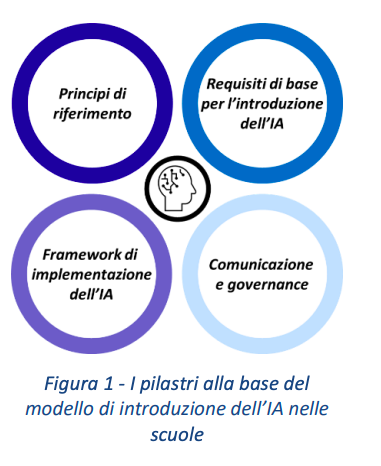
A turning point is represented by Guidelines for the introduction of Artificial Intelligence in educational institutions (2025), which outline a vision of AI anthropocentric, ethical and responsible”, founded on four strategic pillars (Figure 1): guiding principles, basic requirements for the introduction of AI, implementation framework, e communication and governance.
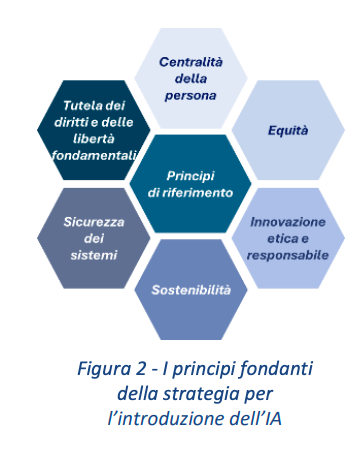
I founding principles of the strategy (Figure 2) are person-centricity, equity, sustainability, system security, the protection of fundamental rights, and ethical and responsible innovation.
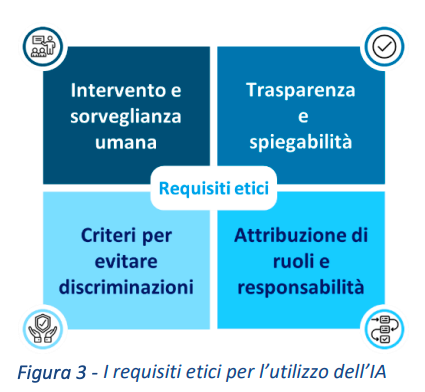
From an operational standpoint, the guidelines also identify the ethical requirements for the use of AI in schools (summarized in Figure 3), including:
- human oversight and transparency in automated decision-making processes;
- criteria to avoid discrimination;
- a clear one assignment of roles and responsibilities to ensure safe and conscious use.
One of the most relevant aspects concerns the school staff training, indicated as a strategic lever to ensure an effective transition. The guidelines provide for:
- the activation of specific training paths by ministerial decrees;
- the creation of a national digital platform to share resources, catalog trials, and promote good practices;
- the integration of AI into instructional design, in assessment and in inclusion strategies.
Along with these is the “School 4.0” Plan”, funded by the NRRP (National Recovery and Resilience Plan), which provides training pathways on advanced digital skills and the use of emerging technologies, including AI, extended reality, and immersive environments. The goal is to transform schools into “innovative learning environments” and support teachers in this change.
Alongside national policies, the bottom-up training initiatives And I pilot projects, such as the aforementioned 2023–2025 OECD project and ISIS Europe, and the creation of community of practice between teachers, tech figures, and researchers.
Not least is the introduction of education on digital citizenship as a cross-curricular subject (Law no. 92/2019), reinforced by STEM guidelines and from there Ministerial Decree no. 183/2024 on the teaching of AI as a tool for civic and technological literacy.
However, for AI to truly be an opportunity for fairness and innovation, it is necessary to invest in the growth of teachers, offering real opportunities for discussion, training, and experimentation. Creating networks, communities of practice, and spaces where mistakes are accepted and exploration is encouraged, because no technological transition makes sense without a human transition. And this also involves training.
Inclusion or exclusion? The risks of AI
Generative AI has the potential to radically transform education by making it more inclusive, personalized, and accessible. But as is often the case with emerging technologies, the promises go hand in hand with risks that require careful governance, ethical oversight, and clear public policies.
Digital divides, bias, and privacy
According to the OECD, nearly 30% of students in disadvantaged schools do not have access to adequate digital tools, compared to less than 20% in wealthier schools. Furthermore, access to the most advanced Gen-AI models is often limited to those with up-to-date devices, stable internet connections, digital skills, and familiarity with the English language, effectively excluding those who are not represented in the data used to train the AI.
Algorithmic biases are also a real risk: studies have shown that some facial recognition systems are up to 100 times more likely to make errors when recognizing non-Caucasian individuals.
A further critical aspect concerns privacy. In Europe, the General Data Protection Regulation (GDPR) imposes stringent rules on the collection of personal data, and’European AI Act explicitly bans the use of AI for emotional profiling in schools. AI-based educational technologies are considered “high risk” and must comply with requirements for transparency, human oversight, and enhanced protection for minors.
To integrate AI in an ethical and sustainable way, it is essential that technology serves the person, not the other way around. Human supervision remains essential, especially in sensitive contexts such as student evaluation or guidance.
Among the risks to monitor:
- cognitive addiction: Excessive use of AI can reduce the exercise of critical thinking, creativity, and problem solving.
- content reliability: Generative models can produce incorrect or misleading content., putting the quality of learning at risk.
- impoverished educational relationships: Replacing human interactions with automated systems risks compromising empathy, listening, and dialogue.
Towards the school of the future: AI literacy
Develop a real Artificial Intelligence literacy it is no longer an option, but an educational and social priority. Like reading and writing, even understanding and using AI consciously is now considered a citizenship competence.
UNESCO was among the first international institutions to emphasize the centrality of AI literacy, highlighting in Beijing Consensus on Artificial Intelligence and Education the need to integrate skills into educational systems to “think critically and responsibly” about the use of AI. Also the European Commission states, in its AI Act, that the deployment of AI in education must go hand in hand with the development of digital skills, media literacy, and critical thinking, to enable citizens to participate consciously in democratic processes.
In Italy, the Ministry of Education and Merit published in 2025 the Guidelines for the introduction of AI in educational institutions, integrating AI literacy into the framework of digital citizenship education provided by Law 92/2019.
The’AI literacy It is based on three main pillars:
- conceptual literacyunderstand how algorithms work, what data they learn from, and with what logic and limitations.
- critical literacyrecognizing bias, ethical implications, and social impacts of AI use.
- creative literacy: knowing how to use AI actively and responsibly, by formulating effective prompts, co-creating content, and evaluating outputs with a critical eye.
Teaching AI isn't just about talking about technology, but provide students with the tools to consciously inhabit their time, making artificial intelligence an ally in building the future.
A concrete example of a playful and inclusive approach to AI literacy in schools is Prompt’n’Play for kids, the version of Prompt’n’Play developed by us at Flowerista and designed for girls and boys aged 6 to 14. Our serious game allows them to experiment with prompt writing in a collaborative, creative, and mindful way, thanks to a card system and the support of an AI assistant that guides participants with immediate and personalized feedback. All of this takes place in a safe and guided environment that enhances curiosity, communication, and critical thinking, in line with the pillars of AI literacy promoted by UNESCO and the European Commission.
A human-centric school: technology at the service of the teacher
In the debate on AI at school, there is one principle that must remain firm: the centrality of the person. UNESCO speaks of a humanistic approach to describe a use of AI that does not replace, but enhance human capabilities. Also the MIM guidelines They reiterate it strongly: AI must be designed and used to extend intellectual, relational, and social capabilities of teachers and students, not to compress or standardize them.
The teacher, in this context, does not disappear. They change roles, becoming ethical guide, complex learning facilitator, and curator of intelligent educational environments. He or she must be trained to understand the mechanisms and epistemological limits of generative models, and at the same time must know how to integrate them creatively into instructional design. It is he or she who human deployer provided by’AI Act, responsible for monitoring, supervising and, if necessary, intervene in real time to correct, prevent, or block inappropriate AI system behaviors.
Furthermore, Ethics of Care by Design, proposed in the educational field, suggests that ethics should not come as an afterthought, but be an integral part of the design of educational technologies.
The priorities for the Italian school system today
Artificial Intelligence has entered the classroom, bringing with it new and necessary questions. What does it mean to teach in an era when access to information is instantaneous? How do we cultivate critical thinking when we live alongside systems that generate seemingly flawless texts on a daily basis?
The answers are not simple. But one thing is clear: AI cannot be passively endured; it must be understood, governed, and directed. We need to rethink school as a relational, ethical, and creative space where students and teachers grow together, also thanks to AI.
The priorities, then, become clear:
- develop a’AI literacy diffuse, included in curricula and teacher training, starting from primary schools;
- design evaluative and educational models consistent with the complexity of the present, where collaboration with AI is a skill and not a shortcut;
- guarantee fairness of access, data protection and algorithmic transparency, as already outlined by the’AI Act European and the MIM Guidelines;
- experimenting with innovative tools and languages, like our Prompt’n’Play for kids, to teach how to converse with AI in an ethical and conscious way.
AI presents us with an educational challenge, but also an opportunity: reinvent school as a place where technology and humanity intertwine to shape free, critical citizens capable of navigating the future.
Want to dive deeper? In the Notebook LM we prepared, you'll find some sources that inspired this article. Explore it here clicking here!
KEY TAKEAWAYS
Key data
- AI can automate up to 40% of the teaching profession (McKinsey 2019 estimate).
- Adaptive learning platforms like Mindspark they reduced learning gaps in students with different levels.
- About 30% of students in disadvantaged schools do not have access to adequate devices (OECD data).
- Human supervision is always required.
Concrete actions for schools
- Introduce AI literacy as early as primary school with simple and guided activities.
- Use AI to customize exercises, feedback, and support for students with specific learning disabilities (SLD/SEN).
- Train teachers on: critical use of AI, bias, privacy, instructional design.
- Experimenting with AI tools to facilitate bureaucracy (schedules, registrations, documents).
- Integrate evaluation rubrics that include process, reflection, and collaboration with AI.
Risks to keep under control
- Digital divides among students with and without devices.
- Algorithmic biases, especially in systems that analyze text or images.
- Minors' privacy (GDPR + European AI Act).
- Risk of cognitive dependency: students who rely too much on AI.

Digital Marketing Manager and Head of the Game-based Learning Area
I work between responsible innovation and experiential learning, supporting organizations and communities in navigating complexity through play.